 Skip-the-line available
 The Story of Lascaux: From 1940 Discovery to Lascaux IV
How four teenagers and a dog found the cave in 1940, why it was sealed in 1963, and the lineage of replicas that led to Lascaux IV.
On 12 September 1940, four teenagers near Montignac lowered themselves into a hole left by a fallen tree and found walls blazing with painted animals no eye had seen for some 17,000 years. Within a generation that discovery had become a tragedy of its own success: by 1963 the breath of crowds was killing the art, and the cave was sealed forever. What followed is one of the strangest and most ambitious conservation stories in heritage — a lineage of replicas, each more complete than the last, culminating in Lascaux IV. This guide tells the whole arc: the discovery, the famous halls, the sickness, the closure, and how Lascaux II, III and IV each tried to give the world back a cave it could no longer enter.
The Discovery: 12 September 1940
The find came almost by accident, in the early months of the German occupation of France. On 12 September 1940, an 18-year-old apprentice mechanic named Marcel Ravidat was walking the wooded hill of Lascaux above Montignac when his dog, Robot, drew his attention to a hole said to have been opened by an uprooted tree. Returning with three friends — Jacques Marsal, Georges Agnel and Simon Coencas — Ravidat squeezed down a narrow shaft into the dark. The boys' improvised lamp lit walls covered with great aurochs, horses and stags, painted with a confidence that overturned every assumption about 'primitive' prehistoric people. They had found one of the supreme works of Ice-Age art, sealed and pristine for roughly 17,000 years.
The young discoverers grasped at once that they had found something extraordinary, and kept watch over the cave. They soon brought in the prehistorian Abbé Henri Breuil, the leading authority of the day, who confirmed the paintings' authenticity and Palaeolithic age. Marsal in particular devoted much of his life to Lascaux, becoming one of its guardians and guides. The story of four ordinary teenagers stumbling onto a masterpiece in wartime is one of the most beloved in archaeology — and it is told vividly at Lascaux IV, where the human drama of the find frames the experience of the recreated cave itself.
What They Found: the Hall of the Bulls and Beyond
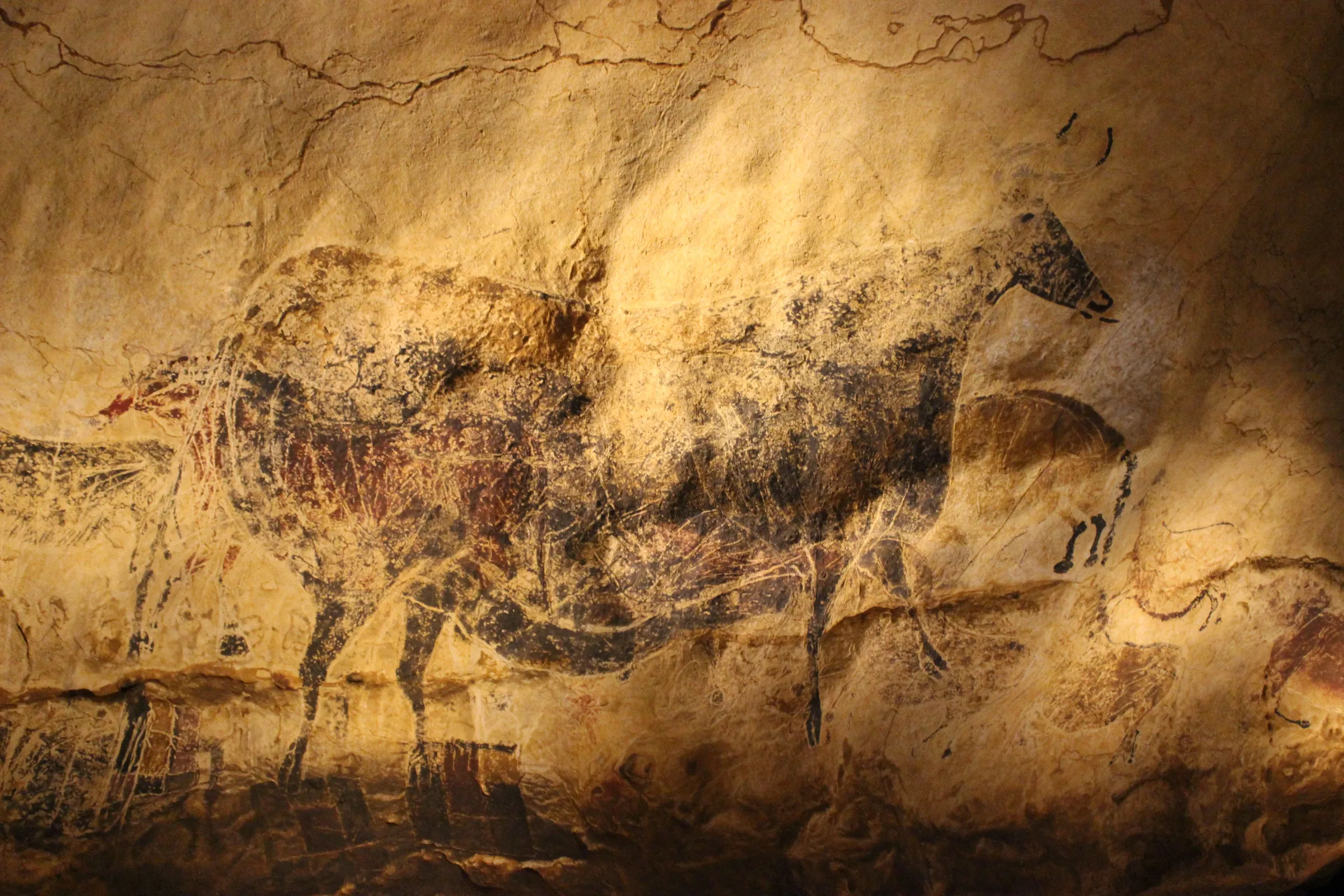
The cave the boys entered runs as a sequence of chambers, each with its own character. The first and most overwhelming is the Hall of the Bulls — a rotunda whose curving pale walls carry great painted aurochs, horses and deer, including an aurochs more than five metres long, the largest animal figure known in cave art. From there the Axial Gallery branches off, a narrow corridor crowded with horses and the famous 'falling' or upside-down horse, painted to follow the curve of the rock. Together these two chambers hold many of the images reproduced in photographs the world over, and they remain the dramatic heart of any visit.
Deeper in lie the Passage, the Nave with its frieze of swimming stags and the celebrated 'Crossed Bison', the engraved Apse, and finally the Shaft — the cave's most enigmatic space. There, in a scene often called the 'Scene of the Dead Man', a bird-headed human figure with outstretched arms falls before a wounded bison, with a rhinoceros nearby and a bird perched on a staff below. It is the only significant human figure in the whole cave, and one of the most debated images in all of prehistory. Across the galleries are roughly 600 painted and drawn figures and nearly 1,500 engravings — and every one of them is recreated at Lascaux IV.
The Sickness and the Closure of 1963
After the Second World War, Lascaux opened to the public and became a sensation, drawing huge crowds through the 1950s. That popularity proved its undoing. The breath of large numbers of visitors released carbon dioxide and water vapour, raising the cave's temperature and humidity and disturbing a microclimate that had held stable for 17,000 years. By the late 1950s a green algae — the so-called 'green sickness' — was spreading across the walls, soon followed by veils of white calcite, the 'white sickness'. The paintings that had survived since the Ice Age were visibly deteriorating within two decades of being rediscovered.
In 1963 the French authorities, under the Minister of Cultural Affairs André Malraux, took the difficult decision to close the original cave to the public to save the art. It has never reopened. Today the cave is monitored continuously in carefully controlled, near-dark conditions by a small specialist team, who have battled successive outbreaks of mould and microbial growth over the decades. No tourist enters under any ticket. This is the honest foundation of every Lascaux visit: the masterpiece is real and ancient, but it is sealed away forever for its own survival — which is precisely why the replicas exist.
The Lineage of Replicas: Lascaux II, III and IV
The first answer came in 1983 with Lascaux II, opened a few hundred metres from the original cave. Built over years by a team of artists working from photographs and measurements, it reproduces about 80 per cent of the paintings, concentrated in the two most famous chambers — the Hall of the Bulls and the Axial Gallery. It was the first full cave facsimile in the world and still operates today, a remarkable achievement that proved a replica could move visitors as the real cave once had. But it was always partial: it gave you the showpiece galleries, not the whole cave.
Lascaux III, conceived in 2010 and first shown in Bordeaux in 2012, took a different path — a fully demountable, travelling exhibition, the first and only one ever devoted to a decorated cave. Using a 'stone veil' technology that reproduces the rock surface on lightweight panels, it recreates several parts of the cave not shown at Lascaux II and has toured museums around the world, bringing Lascaux to audiences who could never reach the Dordogne. Then in December 2016 came Lascaux IV, the International Centre for Cave Art, designed by the Norwegian firm Snøhetta and set into the hillside below the real cave — the first replica to recreate the entire cave at full scale, the modern flagship that the other three led up to.
How Lascaux IV Completes the Story
Lascaux IV is the fullest answer yet to the dilemma the 1963 closure created. Where Lascaux II gave two galleries and Lascaux III travelled with a handful of panels, Lascaux IV reproduces the whole cave — the entire sequence from the Hall of the Bulls through the Nave, the Shaft and the engraved galleries — at full scale and to the millimetre. Specialist artists and 3D-imaging teams worked from precise laser scans of the original to recreate the rock contours and every painted and engraved line, then reproduced the paintings using techniques close to those of the originals. Kept cool and dimly lit, it lets you walk the complete cave as the discoverers did in 1940.
Around the recreated cave, the International Centre for Cave Art adds what no earlier replica could: workshop galleries that let you study the art up close, a 3D cinema, and interactive exhibits that place Lascaux in the wider story of Ice-Age art. A tablet companion guides you through in your own language. The effect is to close the circle opened in 1940 — the masterpiece the four boys found, lost to the public in 1963, is once again something the world can stand inside, while the irreplaceable original stays safe in the dark above. For most visitors, walking Lascaux IV is the closest anyone alive will ever get to the cave itself.
Frequently asked
Who discovered the Lascaux cave and when?
Four teenagers — Marcel Ravidat, Jacques Marsal, Georges Agnel and Simon Coencas — discovered it on 12 September 1940 near Montignac, after Ravidat's dog drew attention to a hole left by a fallen tree. Inside were Ice-Age paintings hidden for roughly 17,000 years.
Why was the original Lascaux cave closed?
Visitor breath raised the cave's humidity and carbon dioxide, triggering a green algae ('green sickness') and later white calcite that damaged the paintings. In 1963 the authorities, under André Malraux, closed it to the public to save the art. It has never reopened.
What is the difference between Lascaux II, III and IV?
Lascaux II (1983) reproduces about 80% of the paintings in two galleries. Lascaux III (from 2012) is a travelling exhibition of several panels that tours the world. Lascaux IV (2016) is the complete full-scale recreation of the entire cave — the definitive modern visit.
What is the Hall of the Bulls?
It is Lascaux's most famous chamber — a rotunda covered with great painted aurochs, horses and deer, including an aurochs over five metres long, the largest animal figure in any known cave art. It is fully recreated at Lascaux IV.
What is the Scene of the Dead Man in the Shaft?
It is the cave's most enigmatic image: a bird-headed human figure falling before a wounded bison, with a rhinoceros nearby and a bird on a staff below. It is the only significant human figure at Lascaux and one of the most debated scenes in all of prehistory.
How old are the Lascaux paintings?
Roughly 17,000 years old, made by Magdalenian hunter-gatherers in the Upper Palaeolithic. With around 600 painted figures and nearly 1,500 engravings, Lascaux is one of the greatest surviving works of Ice-Age art.
Can I still visit Lascaux II?
Yes — Lascaux II still operates near the original cave and reproduces the Hall of the Bulls and the Axial Gallery. But for the complete experience of the whole cave plus the International Centre for Cave Art, most visitors choose Lascaux IV.
Is Lascaux a UNESCO World Heritage Site?
Yes. Lascaux was inscribed in 1979 as part of the 'Prehistoric Sites and Decorated Caves of the Vézère Valley', a group of Dordogne caves and rock shelters forming one of the world's most important records of prehistoric art.